 |
| Receiving letter of appointment as Head of Centre, Centre of Research, Evaluation & ICT Development, IAB Main Campus, Bandar Enstek, from the Director, Dato' Khairil Awang. Effective 16 May 2014 |
Wednesday, May 21, 2014
Head of Centre, Centre of Research, Evaluation & ICT Development


Wednesday, April 30, 2014
Research Workshop
 |
| Facilitating a workshop on research activities for IAB senior lecturers at Kuala Lumpur International Hotel. 7 - 9 April 2014   |
Friday, April 4, 2014
Promotion to Grade DG54
 |
| Photo session with IAB's Director, Dato' Hj. Khairil Awang after receiving letter of promotion to Grade DG54. Front row: L-R : Rahimi, Hamzah, Mohd Zanal (Branch Director, IABU), Dato' Khairil, Dr. Abdul Zubir (Deputy Branch Director, IABU), Dr. Sazali, Norihan 2nd Row, L-R : Elhammi, Dr. Balasandran, Mohd Rosidi, Nasaruddin 31 March 2014 |
Friday, November 29, 2013
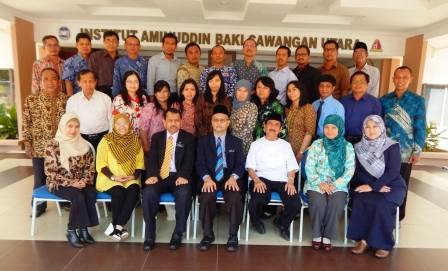
Professional Development Course for Indonesian Headmasters (24-27 Nov 2013)
  |
| In a classroom |
 |
| One of the participant - Jenk Noenk |
 |
| A shot with IAB Northern Branch Director, Mohd Zanal Dirin |
 |
| In a computer lab. ICT in School Management delivered by Elhammi Ahmad and Zamri Abu Bakar |
The participants are from Yogyakarta and Surabaya.
Saturday, November 23, 2013
My New Book (co-authored with Suzana Abdul Latiff)
This book can be downloaded at this site :
http://myrepositori.pnm.gov.my/xmlui/handle/123456789/3477?show=full
 |
| Book cover. We were honoured that Prof. Dr. Tony Bush from The Nottingham University, UK wrote the foreword of the book. |
CONTENT
FOREWORD
FOREWORD
I am pleased to have the opportunity to provide a foreword for this important new book on
leadership development. The significance of specific preparation and development for school
principals, and other leaders, is increasingly recognized and Malaysia makes a valuable
contribution to this process through the work of the Institut Aminuddin Baki, the National
Institute of Educational Leadership and Management, where both authors are employed.
Suzana Abd Latif and Sazali Yusoff have produced an engaging text which connects ideas on
school leadership to notions of leadership development, drawing on a wide range of
international research and literature. The book is intended as a reference point for scholars,
educational leaders and practitioners and is likely to be particularly helpful for the latter
groups. The authors make the important point that leadership is not a uni-dimensional
phenomenon and they also stress that it is both a practical and a theoretical concept.
The first part of the book, ‘Educational Leadership and Management’, sets the scene and
introduces the three dimensions of capacity, capability and competency, which inform the rest
of the text. The authors also make a significant distinction between ‘self’, ‘other’, and
organization, which is a useful device for reflective leaders and practitioners. Self-knowledge is
regarded as increasingly important and the international literature shows clearly that leaders’
impact on school and student outcomes is indirect, exerted through colleagues and other
stakeholders. The authors’ focus on the organization is also very welcome because it shifts the
lens from individual leaders, the core of most texts on this subject, to leadership, which is a
Part two focuses on developing leadership capacity and the authors identify four key elements
of this construct; knowledge, skill, attitude and drive. This is a helpful distinction because many
leadership development programmes focus primarily on knowledge acquisition and under-
represent the other more practical dimensions. The best international practice addresses
understanding, what leaders know and need to know, and application, how leaders develop
their skills and apply their learning to their school contexts.
The final part examines how leadership capability can be enhanced. There is an important
distinction to be made between capacity and capability and the authors do this in a helpful way.
They stress the interdependence of self, other and organization, discussed earlier, and link
them to the key notions of structure, culture and character. They conclude by stressing the
need for principals to shape and reshape their work as educational leaders.
This book is likely to be of great value for aspiring and current leaders and I hope that the
authors will consider preparing a companion volume that will reflect on the leadership
preparation and development opportunities available to Malaysian principals and their impact
on school and student outcomes.
Professor Tony Bush
University of Nottingham (UK and Malaysia)
PART 1. EDUCATIONAL LEADERSHIP AND DEVELOPMENT
1.1 Points of Departure
1.2 A Dynamic
Disequilibrium
1.3 Leadership
Development : An Integrated Model
PART 2. DEVELOPING LEADERSHIP CAPACITY
2.1 Knowledge, Skill,
Attitude and Drive
2.2 Skills
2.3 Attitude
2.4 Drive
PART 3. ENHANCING LEADERSHIP CAPABILITY
3.1 Self, Other,
Organization : An Interdependency
3.2 The Self : The
Multiplicity of Roles and Function
3.3 The Others : “The
Heart and soul of an organization”
3.4 Organization : Its
Structure, Culture and Character
CONCLUSION
BIBLIOGRAPHIES
3rd RCELAM 2013 (19 - 21 November 2013) - Genting Highlands
 |
| Dato' Seri Idris Jusoh - Minister of Education Malaysia officiating the Opening Ceremony of 3rd RCELAM 2011 |
 |
| Keynote Speech 1 : Prof. Dr. Tony Bush - The Nottingham University, UK. Topic : SCHOOL LEADERSHIP IN THE 21st CENTURY: GLOBAL PERSPECTIVES
Education is increasingly regarded
as the key to economic and social development.
Many governments, including Malaysia, are reforming their education
systems to bring about school improvement.
This paper will explore the leadership implications of educational
reform, in recognition that change succeeds, or may falter, at the school
level. The paper will examine the
nature and scope of school leadership and consider how good leaders manage
their schools. The Malaysia Education
Blueprint (Ministry of Education 2012) advocates instructional leadership and
the paper will address what this means for school leaders. The paper will consider the evidence on the
impact of school leadership on learner outcomes and discuss the implications of
reform for the development of leaders. .......
|
 |
| Keynote Address 2 : Prof. Tan Sri Dzulkifli Abdul Razak - President International Association of Universities, Paris. Topic : Exploring
new possibilities in the era of sustainability
Education
will be facing a period uncertainty as we approach the end of several of global
agenda such as Education for All, and the Millennium Development Goals in 2015.
The last decade has witnessed education being challenged by the need to
construct new vision and pathway towards sustainability, be it with respect to
learning and teaching processes, curriculum design and quality systems towards
sustainable development. The post-2015 development agenda will most likely to
further challenge education by requiring new leadership and management skills
in reorienting education for sustainability in the 21st century.
|
 |
| Keynote Address 3 : Dr. David Zyngier - Monash University, Melbourne Australia. Topic : Education for Democracy : Exploring New Possibilities globally and locally. What the research suggests.
This paper reports on the research of
the international Global Doing Democracy Research Project, which
currently has some 50 scholars in over 25 countries examining perspectives and
perceptions of democracy in education in order to develop a more robust and
critical democratic education among pre- and in-service teachers, teacher
education academics, and educators, in general. The focus of the project is on
how education supports, cultivates and engages in, and with, democracy
|
 |
| Keynote Address 4 : Prof. Alma Harris, Professor and Director, Institute of Educational Leadership, University of Malaya Topic : Leading School and System Transformation |
School and system improvement will not be secured without a shift in emphasis from knowledge exchange to knowledge creation. This will require greater innovation and creativity in our schools and school systems than ever before. However the challenges associated with this shift cannot be underestimated. This keynote focuses on the challenges, potential and possibilities of school and system transformation. It explores how creativity and innovation can be secured at scale through a combination of collaboration and consolidation. It considers the type of educational leadership required to support such change and argues for distributed leadership where it is expertise, rather than role, than defines the leader. It argues that distributed leadership 'matters' and that if we are serious about school and system transformation we need forms of leadership that will help lead us into the future and not those rooted in the past.
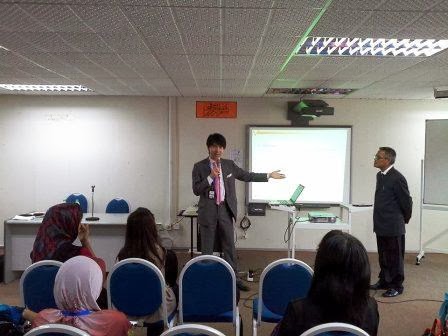
Presenter from Japan, Dr. Yusuke Suzumura
  |
| With delegates from Kazakstan (Maganat & Aisham), Uzbekistan (Makhprat & Anvar) & Australia (Jessica Gnata) |
 |
| With delegates from Maldives, South Africa, Kazakhstan and Uzbekistan |
 |
| With Jessica Gnata from Australia |
 |
| Miss Hala from Egypt presenting her paper on Blended Learning |
 |
| Dr. Maganat from Kazakhstan talked on Leadership and Trust |
 |
| Dr. Sumitha, presenter from India |

 |
| Mr. Adeel from Egypt presenting his paper in Arabic. |

 |
| Michelle from New Zealand talking on Leadership Coaching |
 |
| Participants from Nigeria |
 |
| One of the parallel sessions |
 |
| In the auditorium for keynote address |
 |
| Delegates from Saudi Arabia |
Friday, August 30, 2013
Meeting with Prof. Tony Bush - The University of Nottingham, Malaysia Campus
The aim of the meeting was to familiarize Prof. Bush, 3rd RCELAM 2013 keynote speaker, with IAB. The discussion was expanded to paving the opportunities of collaboration between IAB and UNMC in the area of training, capacity building, faculty exchange, research, and publication. UNMC has given IAB's staff a flexibility who wish to pursue their Ph.D. at UNMC.

 |
| Shahrizal, (PADU), Dr. Ashley (UNMC), Rokiyah, Norihan, Dr. Zainab (Deputy Director, IAB), Prof. Tony Bush, Gana (Director of Studies, UNMC), Dr. Rafee, Zanal, Dr. Yusof, Dr. Sazali - Venue : Pearl International Hotel, KL, 29 Aug. 2013 |

Saturday, June 1, 2013
SPECIALIST TRAINER WORKSHOP FOR IAB's SENIOR LECTURERS
 |
Facilitating a workshop for IAB's senior lecturers on Training Need Analysis and Designing Training Program (29 - 31 May 2013) The participants Seating, L-R : Dr. Zaiton (Head of Center), Shaufi, me, Zulkifli (workshop Manager), Dr. Yusof (Head of Center), Dr. Kamaruzaman (Facilitator), Chew (Facilitator), Liew, Dr. Sulaiman (Head of Center) Standing 1st row : Ismail, Raja, Samihah, Siti Zaleha, Dr. Quah, Noraida, Nazhatul Shima, Noriza, Norlaila, Parimala Standing 2nd row : Chua, Salina, Wan Zakiah, Ustaz Shaiful, Salehuddin, Yahaya, Rahimi, Wan Ghazali, Razak Standing 3rd row : Wan Faizal, Azami, Mohamed |
Subscribe to:
Posts (Atom)