Wednesday, June 14, 2017


Monday, May 22, 2017
LEADERSHIP DEVELOPMENT FOR EDUCATIONAL LEADERS : AN INTEGRATED MODEL
LEADERSHIP
DEVELOPMENT FOR EDUCATIONAL LEADERS :
AN
INTEGRATED MODEL
By
Suzana
Abd Latif
Sazali
Yusoff
Institut
Aminuddin Baki
Ministry
of Education Malaysia
The rapid expansion of globalization during the past decades has
inevitably led to the dissemination of new knowledge and information within the
educational sphere across countries and continents. As knowledge workers in today’s competitive global market,
educational leaders need to think through the organization’s mission, set its
aims, lead and manage the resources for the achievement the organization has to
contribute. They need to be able to deal with increasingly
challenging national and global issues which inevitably point to the monumental
obligation of acquiring crucial competencies to keep abreast of or even ahead
from the current competitive global environment. The constant, accelerating,
unpredictable change in today’s global competitive environment demands better
leadership to be employed in order to provide right courses of direction and
action through uncertain and challenging times. As we
believe that leadership process is dynamic, the ‘force’ underlying any
leadership process, indisputably, is the leader. It is our belief that
educational leaders are indeed the centripetal and centrifugal forces
responsible for the enhancement of their leadership repertoire. It is with this
awareness that we attempt to transform the conscious of many into perceiving
leadership process as involving dynamic entities who affect and are affected by
their environmental determinants. Thus, this paper attempts to offer a more
potent approach through the conceptualization of an integrated model of
leadership. We posit that in order for the educational leaders to develop their
leadership competency, they need to be aware of their position as defined and determined
within the multiple socio-organizational structures as well as their
role-relations with the others and their functions in the organization. In
addition, within this systemic framework we also attempt to highlight the
integration of leadership capacity and leadership capability as fundamentals of
leadership competency, of which every educational leader needs to be aware of
and work on.
Keywords : Leadership, development, competency,
capacity, capability
This paper was presented at 1st International Conference on Exploring Leadership and Learning Theories in Asia (ELLTA). Penang, Malaysia on 15 -17 February 2011
KuBU IAB
Capacity-Building Group
(KuBU) : An approach to enhance professionalism among Institut Aminuddin Baki (IAB)
lecturers
Sazali Yusoff, Ph.D.
Malaysia
-->
In cognizant of multiple approaches in enhancing professionals in
various institutions or organizations, and with regard of that every institution
is unique in their business and entity, this paper attempts to conceptualize
the approach of enhancing the capacity of IAB lecturers. Capacity-Building
Group (KuBU) is an approach rooted in team-building theory which is then
expanded and used in Professional Learning Community, Lesson Study and other
forms of group work. KuBU is conceptualized as a culture of peer-assistance in
enhancing their capacity. There are three elements that constitute capacity in
KuBU, they are competency, capability and self-efficacy. Hence, KuBU is a
process for a continuous learning, working collaboratively, and allowing
knowledge being disseminated professionally and systematically among its
members. Preliminary findings through observation and conversation found that
KuBU members were satisfied with the initiative and believe they have benefited
meaningfully. Their confidence in delivering lecture has also increased
dramatically albeit measurement of their competency, capability and
self-efficacy has yet to be done scientifically.
Saturday, May 20, 2017
M.Sc. (management)
Abstract of my master thesis
Keberkesanan Konsep Kesejawatanan dalam Pengurusan Sekolah Rendah - Satu Kajian ke atas 35 Buah Sekolah di Negeri Perak
The aim of this research was to study the effectiveness of the "Excellent Neighbourhood" programme which was implemented by Perak State of Education Department in all National Primary Schools in Perak. This programme consists the elements of collegiality and aimed at its practicality among the headmasters. The effectiveness of this programme was measured by the job satisfaction of the teachers in the schools involved. Survey method was used in this research by which the researcher himself developed the questionnaires. There were 35 headmasters and 121 teachers from 35 schools taking part in this research. Generally the finding of this research can be summarised as follows: i) Headmasters had benefited from "Excellent Neighbourhood" programme; ii) There was a significant increase in teachers' job satisfaction during this programme was implemented; iii) There was a significant relationship between collegiality concept practised by the headmasters and the teachers' job satisfaction.
source : http://etd.uum.edu.my/1515/
Tuesday, May 16, 2017
Readiness - India
International Conference on Elevating Learning 3-4 Dec 2011
Principalship readiness among Malaysian senior teachers
Abstract
The aim of this study was to investigate the readiness of senior teachers to
assume school principal post and its relationship with their demographic variables. Principalship readiness was conceptualized as individual’s perceived self-efficacy in school management. A total of 310 aspiring principals from northern states of Malaysia were involved in the study. ‘Malaysian School Principalship Self-efficacy Scale’, MaSPSES (Sazali, 2006) was used to measure the principalship readiness. MaSPSES is a Likert-type scale with 0 to 5 points and has six dimensions which measure an array of school management activities. The dimensions are managing Academic success, managing staff, managing pupil affairs, managing school facilities, managing school finance, and managing school-community affairs. Cronbach alpha coefficients for each dimension were from .719 to .987. Statistics used in the study were t-test, one-way anova, mean and standard deviation. It was found that the means of the aspiring principals’ self-efficacy and it’s dimensions were at ‘moderate upper’ level (3.49 to 3.82). None of the demographic variables (gender, age, academic qualification, professional developments) were associated significantly with respondents’ self-efficacy except the school enrolment factor. It was found that respondents from small schools have higher self-efficacy than those from big schools.
Principalship readiness among Malaysian senior teachers
Abstract
The aim of this study was to investigate the readiness of senior teachers to
assume school principal post and its relationship with their demographic variables. Principalship readiness was conceptualized as individual’s perceived self-efficacy in school management. A total of 310 aspiring principals from northern states of Malaysia were involved in the study. ‘Malaysian School Principalship Self-efficacy Scale’, MaSPSES (Sazali, 2006) was used to measure the principalship readiness. MaSPSES is a Likert-type scale with 0 to 5 points and has six dimensions which measure an array of school management activities. The dimensions are managing Academic success, managing staff, managing pupil affairs, managing school facilities, managing school finance, and managing school-community affairs. Cronbach alpha coefficients for each dimension were from .719 to .987. Statistics used in the study were t-test, one-way anova, mean and standard deviation. It was found that the means of the aspiring principals’ self-efficacy and it’s dimensions were at ‘moderate upper’ level (3.49 to 3.82). None of the demographic variables (gender, age, academic qualification, professional developments) were associated significantly with respondents’ self-efficacy except the school enrolment factor. It was found that respondents from small schools have higher self-efficacy than those from big schools.
Saturday, May 13, 2017
IPSI - ITALY. JULY 2005
International Conference on Internet, Processing, System, Interdisciplinary Research (IPSI),
Pescara, Italy
 |
| Presenters from USA, Republic of Czech, India and New Zealand |
 |
| At the conference venue, Castello Chiola Hotel, Loretto Aprutino, Pescara |
 |
| Loretto Aprutino |
 |
| At the hotel |
 |
| Presenting a paper with a title, The influence of headmasters’ self-efficacy and emotional intelligence toward teachers’ collective efficacy and school climate |
 |
| A central point of transportation in Rome - train, bus and taxi |
 |
| At Roma Termini |
Thursday, May 11, 2017
Nagoya & Tokyo. 10 -13 April 2017
Professional Visit to Nagoya and Tokyo organized by Malaysian Society for Educational Administration and Management (MSEAM)
1. Graduate School of Education, Nagoya University
2. Hara Junior High School, Nagoya
3. Malaysian Embassy, Tokyo

Various clubs and sports were demonstrated to Form One students before they make a decision which club or sport they wanted to join. Beside popular sports such as football, baseball, basketball there is also Japanese famous martial art, bushido, for their option.


1. Graduate School of Education, Nagoya University
2. Hara Junior High School, Nagoya
3. Malaysian Embassy, Tokyo
  |
| Graduate School of Education, Nagoya University, Nagoya. Sitting (L-R): Me, Dr. Shahri, Prof. Dr. Nishino Setsuo, Prof. Emeritus Dato' Dr. Ibrahim Bajunid, Prof. Dr. Mina Hattori, Assoc. Prof. Andy |
 |
| Professional Discussion between GSE Nagoya University with MSEAM |

 |
| Cherry blossom at Nagoya University |
 |
| Exchange of souvenirs between MSEAM and Hara Junior High School |
 |
| Form One students watching their seniors promoting their clubs and sports. |
 |
| Map of Nagoya University |

 |
| At Hara Junior High School |
 |
| Landmark of Japan, Mt. Fuji |
 |
| The oldest temple in Tokyo, Sensoji Temple |
Friday, December 2, 2016
JIWA PENDIDIK
Paper presented at 3rd International Conference on Teacher Learning and Development 2016
Venue : Cititel Hotel, Penang, MalaysiaDate : 28 -30 Nov 2016
MODEL OF JIWA EDUCATOR: A NEW PERSPECTIVE
Sazali bin Yusoff (Ph.D)
Ahmad Sukari bin Mohamad (Ph.D)
Abdul Razak bin Othman (Ph.D)
Siti Rohani binti Mohd Zain (Ph.D)
Studies have shown that the impact of teacher effectiveness on student outcomes is linked with teacher attributes. This has led to a growing interest among educators, the need to identify the attributes that has powerful influence on student outcomes. One of the issues consistently discussed is teacher attributes, particularly the distinctive attributes that distinguish between an ordinary teacher and a teacher with the jiwa of an educator. Hence, this article aims to propose a model of jiwa educator relevant to today’s context. Based on comparative analysis of literature and research work from scholars in the education field as well as interviews with experienced in-service teachers and teacher educators; essential dimensions of teacher knowledge, skills, attributes and values that shape the jiwa of an educator were identified and expanded. Although the core dimensions and elements as conceptualized in the model can be described separately, it is the interactions of all the dimensions and elements within a teaching context that influence and shape the actions and decisions of a teacher who places his/her heart, soul and mind to teaching-- the jiwa educator. In the model, two values namely humaneness and spirituality are highlighted as central to the core attributes of the jiwa educator.
3rd International Conference on Teacher Education and Development 2016
28 Nov 2016 to 30 Nov 2016
Venue : Hotel Cititel Penang, Malaysia
The conference was organised by Institute of Teacher Education Malaysia (IPGM) in collaboration with Malaysian Society for Educational Administration and Management (MSEAM). IPG Tuanku Bainun Campus was entrusted to lead the organising committee.
Venue : Hotel Cititel Penang, Malaysia
The conference was organised by Institute of Teacher Education Malaysia (IPGM) in collaboration with Malaysian Society for Educational Administration and Management (MSEAM). IPG Tuanku Bainun Campus was entrusted to lead the organising committee.
 |
| Datuk Dr. Amin Senin (Deputy Director-General of Education Malaysia) officiating the opening ceremony |
There were more than 250 presenters/participants attended this conference whereby internationals accounted for 25 % of them.
 |
| 1st Keynote Speaker : Datuk Dr. Amin Senin, the Deputy Director-General of Education Malaysia |
 |
| 2nd Keynote Speaker : Emeritus Prof. Dato' Dr. Ibrahim Bajunid, President of MSEAM |
Mesmerising speech by Emeritus Prof. Dato' Dr. Ibrahim which lasted about 2 hours and a half.
 |
| 3rd Keynote Speaker : Prof. Alma Harris, Director of Institute of Educational Leadership, University of Malaya |
 |
| 4th Keynote Speaker : Prof. Fuji, Tokyo Gakugei University, Japan |
 |
| 5th Keynote Speaker : Assoc. Prof. Dr. Wang Xiao Ling, Beijing Institute of Education, China |
 |
| Presenter from the UK: Mr. Roy Andersen |
 |
| Presenter from Pakistan : Prof. Abdul Hameed from University of Management and Technology, Lahore |
 |
| Presenter from the USA, Brianna Rogers |
 |
| Presenters from Australia, Maldives and Malaysia |
 |
| Audience in one of the Keynote sessions |
 |
| Audience in one of the parallel sessions |
 |
| Presenting a paper. Title : Jiwa Educator |
 |
| Keynote Speakers, MSEAM Committee member, Datuk Yaccob and Directors of IPG Campuses |
 |
| MSEAM top Management : L-R : Dr. Amer Hamzah (Treasurer), Emeritus Prof. Dato' Dr. Ibrahim Bajunid (President), Dr. Sazali Yusoff (Secretary-General) |
Saturday, November 12, 2016
1st International Education Conference LCWU, Lahore Pakistan. 2 - 4 Nov. 2016
 |
| A courtesy call to Vice-Chancellor office. Exchange of token with Vice-Chancellor, Prof. Dr. Uzma |
 |
| Delivering Keynote Speech on 'Lifelong Learning' |
 |
| Some of the audience |
 |
| Receiving a token from Dr. Afifa, the coordinator of the conference |

 |
| Ready for the Keynote Address |
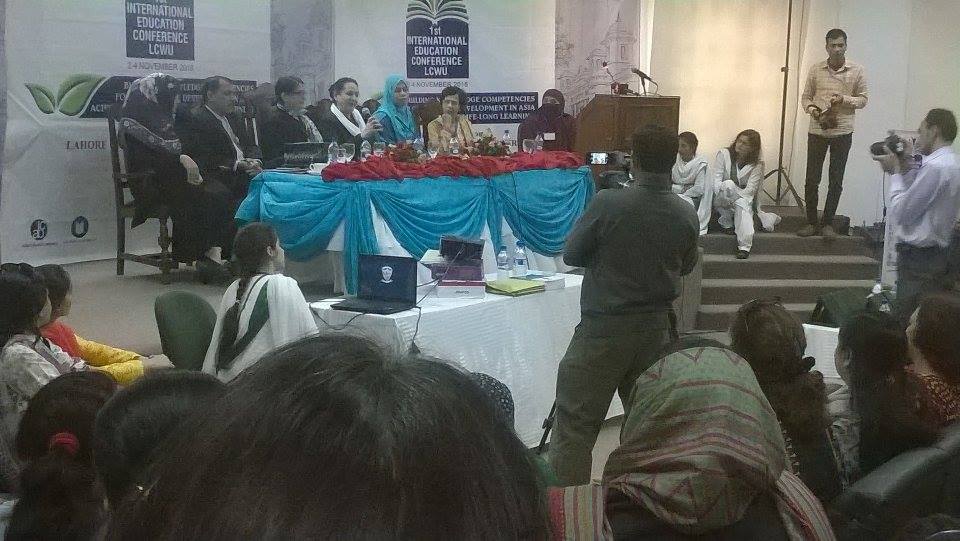 |
| Panel Session - Chaired by VC of LCWU, Prof. Dr. Uzma |
 |
| Responding to the questions during the panel session |
 |
| Receiving a token from Vice-Chancellor of LCWU |
 |
| With Prof. Dr. Mahr and Dr. Farook from Punjab University, Lahore |
 |
| .. Chairing of the session |
 |
| Certificate of Keynote Speech |
Subscribe to:
Posts (Atom)